
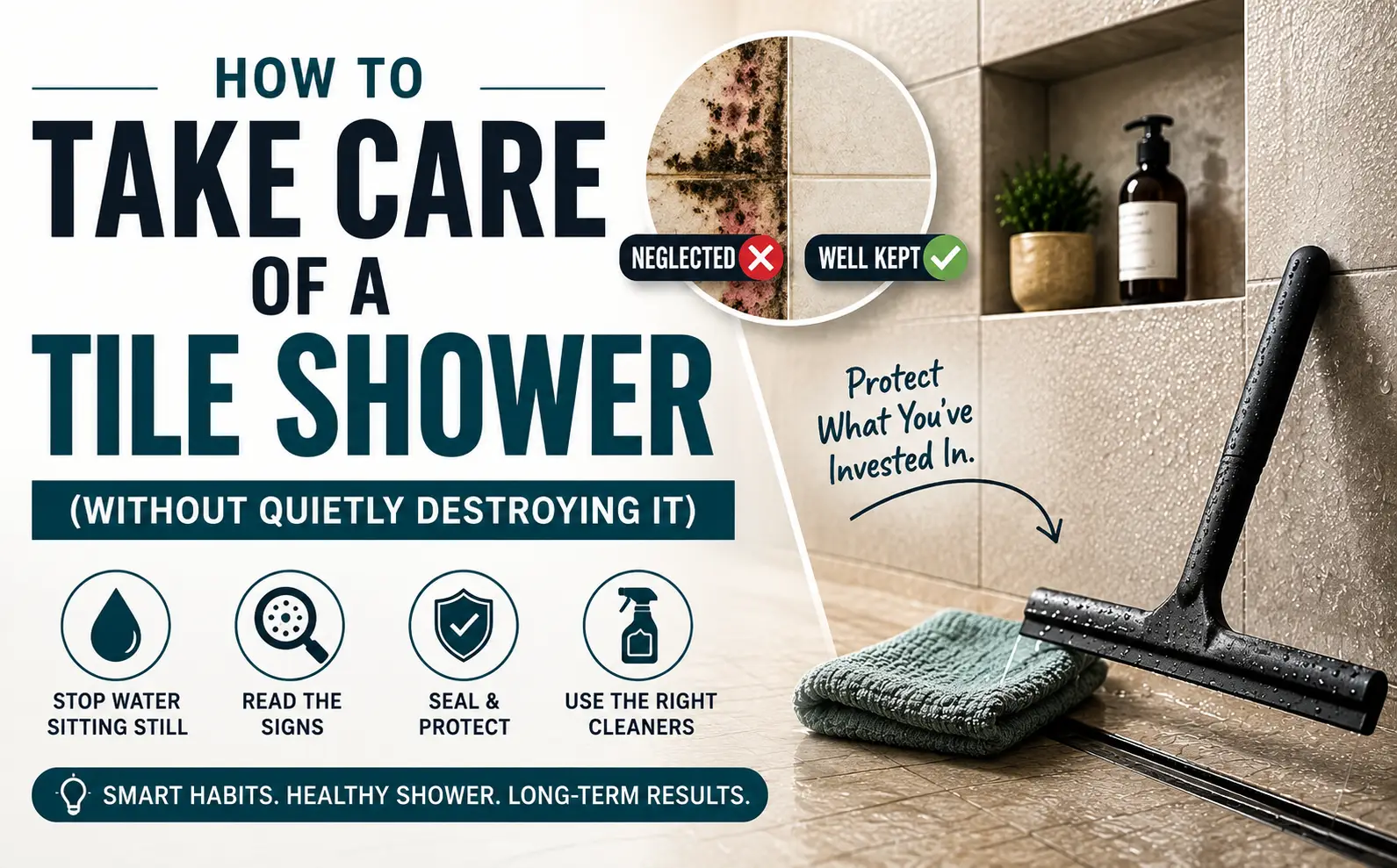
If you search this topic, you’ll find roughly the same article fifteen times: squeegee the walls, use vinegar, run the fan. All true, all useful, all incomplete. None of it explains why tile showers fail, which means none of it helps you stop the failure before it starts.
A tile shower doesn’t degrade because you skipped a cleaning. It degrades because of slow chemistry and physics happening in places you can’t see — inside the grout lines, behind the caulk, in the porous skin of the tile itself. Once you understand what’s actually going on back there, maintenance stops feeling like a chore list and starts making obvious sense. Here’s the version of this guide that respects that.
Your Real Enemy Isn’t Dirt — It’s Water Sitting Still
Soap scum and body oil are cosmetic problems. They’re annoying, but they don’t destroy anything. The thing that actually kills tile showers is standing moisture, because standing moisture is what every destructive process needs to operate.
Grout is cement-based and slightly porous. When water lingers in a grout line, it doesn’t just sit there — it migrates into the grout, carries dissolved minerals with it, and feeds the microbial life that produces those black and pink stains. Mold needs moisture, a food source (soap residue and skin cells), and time. Remove any one of those and it can’t establish. The single highest-leverage habit in tile care is shortening the window during which surfaces stay wet.
This reframes the famous squeegee advice. The point of a squeegee isn’t cleanliness — it’s drying time. You’re not removing dirt, you’re removing the medium that everything bad depends on. Sixty seconds with a squeegee after a shower removes around three-quarters of the water that would otherwise evaporate slowly over the next few hours, taking its dissolved minerals and feeding your grout the whole way.
If you do one thing differently after reading this, make it the squeegee — but now you know it’s not about looks.
The Pink Slime Tells You More Than the Black Mold
Here’s an insight generic blogs skip entirely: the color of your shower growth is diagnostic.
That pink or orange film that appears in grout lines and around drains isn’t mold at all — it’s Serratia marcescens, a bacterium that feeds on fatty soap residues and mineral deposits. Its appearance is a message: you have leftover soap film and the surface is staying damp. Pink shows up fast, often within days, because bacteria reproduce quickly.
Black growth in grout is typically true mold or mildew, and it signals a deeper, more persistent moisture problem — usually poor ventilation or water sitting in the same spot repeatedly.
So before you scrub, read the room. Pink everywhere means your rinse-and-dry routine has a gap. Black concentrated in low corners or where the wall meets the floor means water is pooling there and not drying — a ventilation or slope issue you won’t fix with cleaning alone.
Stop Using Vinegar on Everything
Vinegar is the internet’s default tile cleaner, and on glazed ceramic or porcelain it’s fine for cutting soap scum and hard-water spots. But the blanket recommendation is genuinely bad advice in two common situations, and almost no one flags it.
First: natural stone. If your shower is marble, travertine, limestone, slate, or any other calcium-based stone, vinegar is acidic enough to etch it — permanently dulling and pitting the surface. The damage looks like water spots that won’t wipe away because the stone itself has been chemically eaten. For stone, you need a pH-neutral cleaner, full stop. (The same caution applies to any natural stone countertops elsewhere in your home.)
Natural stone also needs to be resealed far more often than people expect — roughly every 6 to 12 months in a working shower. You can check whether it’s due using the same water-bead test described below for grout: a few drops on the stone should bead up; if they soak in and darken the surface, the seal has worn through and it’s time to reapply.
Second: grout, over time. Even on tile that tolerates acid, repeatedly soaking cement-based grout in vinegar can slowly erode it, weakening the lines you’re trying to protect. Occasional use is fine; a daily vinegar habit is quietly counterproductive.
The smarter default is a pH-neutral cleaner for routine work, with stronger or more acidic products reserved for specific jobs on tile you’ve confirmed can handle them. Knowing what your shower is actually made of is step zero, and a surprising number of people genuinely don’t know.
Sealing Grout: What It Does and What It Absolutely Doesn’t
“Seal your grout” is common advice that’s almost always delivered without the context that makes it useful.
Sealer is a penetrating treatment that fills the pores of cement-based grout so water and stains can’t soak in as easily. It is real and worth doing — but it is not permanent and it is not magic. Two things people get wrong:
It wears off. Sealer in a high-use shower degrades over months, not years. A simple test: drip a few drops of water onto a grout line and watch. If it beads up, your seal is intact. If it soaks in and darkens the grout within a couple of minutes, it’s time to reseal. Do this test seasonally instead of guessing.
Epoxy grout and most modern grout don’t need it. If your shower was tiled recently with epoxy grout or a urethane product, it’s already essentially non-porous, and sealing does little. Sealing is for traditional cement-based grout. Find out which you have before buying a product you may not need.
And critically: sealer slows water absorption, it doesn’t stop standing water from causing problems. It buys you margin, not immunity. You still dry the surfaces.
One more detail that quietly ruins a lot of resealing and re-caulking jobs: the shower has to be completely dry first. Sealers and caulk won’t bond properly to a damp surface — they’ll cure cloudy, peel, or simply fail to keep water out, trapping moisture against the very materials you’re trying to protect. Before you apply any sealer or caulk, let the shower sit unused and drying for 24 to 48 hours so it’s genuinely bone dry, not just dry to the touch. It’s tempting to rush this step, but a sealer applied to a damp surface is often worse than no sealer at all.
The Part Behind the Tile You Can’t Ignore
This is where tile showers genuinely fail catastrophically, and where almost no consumer guide ventures.
Tile and grout are not waterproof. They’re water-resistant. The actual waterproofing in a properly built shower lives behind the tile — a membrane or waterproof backer board that keeps moisture out of your wall framing. Tile is the wear surface; the membrane is the dam.
The quality of that hidden layer is what separates a shower that lasts decades from one that fails in a few years, which is why the system matters. In our own builds we use one of two proven waterproofing systems: Schluter’s KERDI membrane or the Laticrete HYDRO BAN system. Both create a continuous, fully bonded waterproof barrier behind the tile rather than relying on the tile and grout alone — and that’s exactly the kind of detail you can’t inspect or add later, so it’s worth confirming what’s behind your walls before any major work begins.
Why does this matter for maintenance? Because the one place that dam is most vulnerable is at the changes of plane — the inside corners where two walls meet and where walls meet the floor. These spots flex slightly as your house settles and as materials expand and contract with temperature. Rigid grout cracks under that movement. That’s why corners should be filled with flexible caulk, not grout — and why cracked corner grout is an early warning, not a cosmetic blemish.
When you see a hairline crack or gap in a corner, water now has a path past your tile toward the structure behind it. Catching and re-caulking that early is the difference between a ten-minute fix and a full bathroom remodel to repair water-damaged framing. Inspect your corners and the perimeter of your shower floor a few times a year, and treat any gap as urgent.
Ventilation Is a Tile Strategy, Not Just Comfort
Run the fan — sure, everyone says it. But the useful detail is how long and why.
The goal is to pull the humid air out before it can recondense on cool tile surfaces, which is exactly where lingering moisture comes from. A bath fan that runs for the duration of your shower and shuts off the moment you step out is doing maybe half its job, because the bathroom is still saturated. Running the fan for twenty to thirty minutes after you finish is what actually clears the humidity load. A simple timer switch automates this and is one of the highest-return upgrades you can make.
If you don’t have a fan, cracking a window and leaving the shower door or curtain open (not closed, which traps moisture inside the enclosure) is the low-tech substitute. Counterintuitively, leaving things open to dry is better than sealing them up neatly.
A Maintenance Rhythm That’s Actually Realistic
Forget the fantasy daily-deep-clean schedules. Here’s a rhythm built around how the failure modes actually progress:
After every shower (60 seconds): Squeegee the walls and glass. Leave the door or curtain open. Let the fan run on its timer. This single habit prevents the majority of buildup and microbial growth before it starts.
Weekly (5–10 minutes): Wipe down with a pH-neutral cleaner to remove the thin soap film that bacteria feed on. Pay attention to the lower third of the walls and the corners, where water concentrates.
Seasonally (15–20 minutes): Inspect. Run the water-bead test on your grout. Examine every corner and the floor perimeter for cracked caulk or grout. Deep-clean grout lines if staining has crept in. Re-caulk anything questionable now rather than later.
As needed (rare): Reseal cement-based grout when the bead test fails. Re-grout or call a pro if you find soft, crumbling, or persistently discolored grout that cleaning won’t touch — that can indicate moisture has gotten behind the surface.
The One Mindset Shift
Most people clean their tile shower reactively — they scrub when it looks bad. The owners whose showers last twenty years without a remodel do something different: they manage moisture and movement, not appearance. They dry surfaces fast, they watch the corners like a hawk, they know what their tile and grout are actually made of, and they treat a hairline crack as the emergency it quietly is.
Appearance takes care of itself when you take care of the water. Do that, and the squeegee-and-vinegar checklist everyone else is following becomes almost beside the point — because the problems those tips fight were never allowed to start. And when it’s finally time to reimagine the space rather than just maintain it, it helps to see what a thoughtfully built shower looks like from the start — our bathroom remodeling portfolio is a good place to gather ideas.